 FULL OF
CHARACTER.
SMALL THING. BIG CHARACTER.
Knitted-Style Stitch Toy
9.00 €
In stock - ready to print
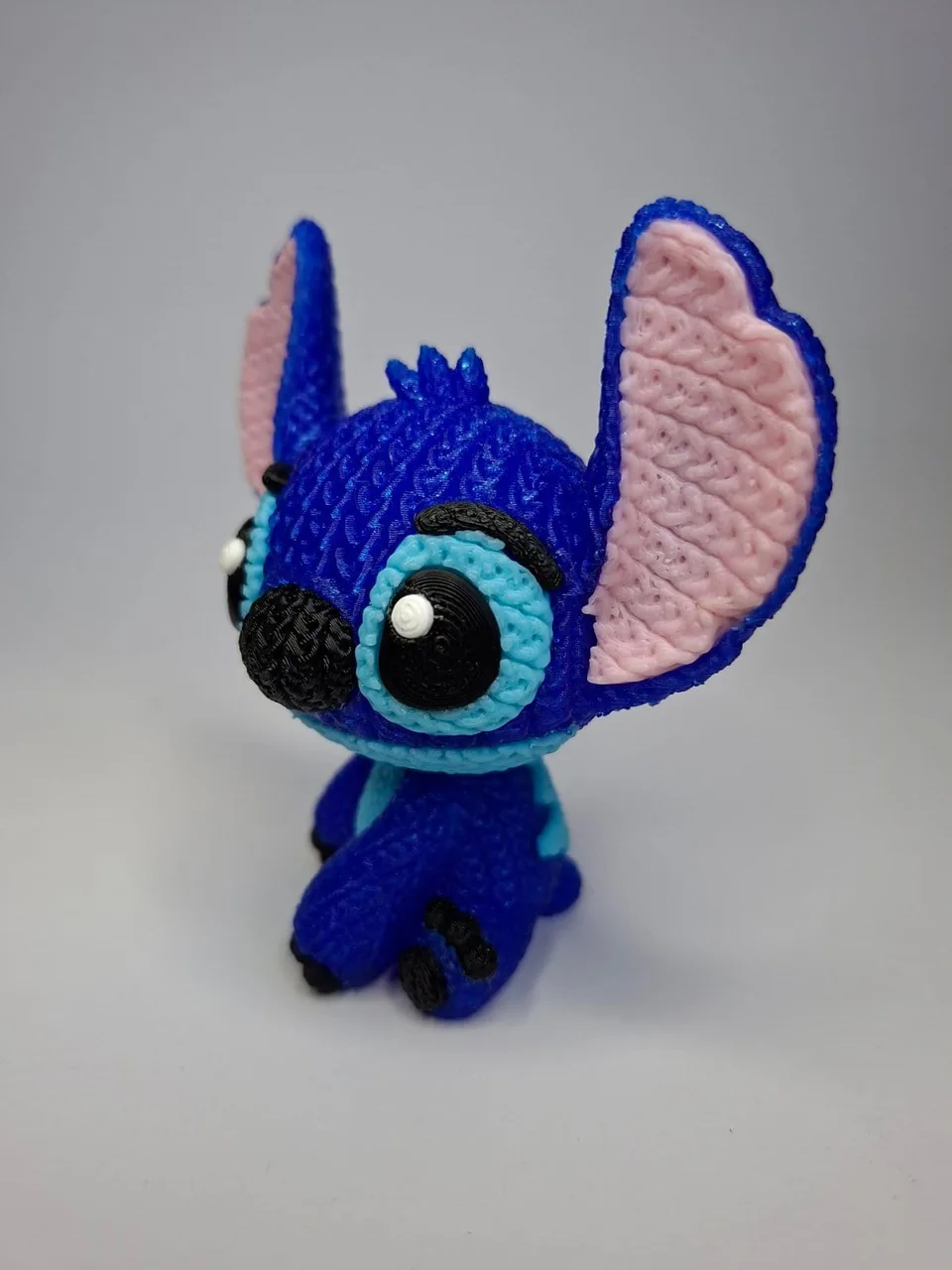
A 9 cm 3D-printed Stitch figure with a distinctive hand-knitted-look texture, a rotating head joint and movable limbs. Made from cobalt blue Bambulab PLA Basic.
✦ 3D-printed in Estonia. Little details, big emotions.
MEET YOUR NEW FAVOURITE
Collectible 9 cm 3D figure of Stitch (Sitting Version), made using FDM printing and based on an official Whale 3D Studio design. The model combines the high level of detail of character Experiment 626 with a unique texture that imitates hand knitting. This overview covers the figure’s technical production details and features that make it a valuable item for collectors and fans of the Lilo & Stitch franchise.
Technical specifications (model passport)
| Parameter | Value | Technical explanation |
|---|---|---|
| 3D model designer | Whale 3D Studio | Using an authorised model ensures accurate proportions and fidelity to the character. |
| Technology | FDM (fused deposition modeling) | An ideal method for creating complex textures such as “Knitted Style”, which cannot be achieved through traditional casting. |
| Material | Bambulab PLA Basic (colour: Cobalt Blue) | Reliable, non-toxic and biodegradable polylactic acid that provides colour stability and strength. |
| Print settings | Layer height: 0.2 mm; infill density: 10% | A balance between visual detail and structural strength. 10% infill is sufficient for a static display piece. |
| Construction | “Rotating Head Joint”, movable limbs | Allows the head to rotate freely and poses to be adjusted without the wear risk associated with a simple joint. |
| Support structures | Tree supports (20° angle) | Used to print overhanging parts, such as the chin and ears, accurately. They are easy to remove without damaging the surface. |
Why is the “Knitted Style” texture technically better than a smooth print?
This is a collectible 9 cm figure of Stitch, created using 3D printing. Its defining feature is a unique surface texture that imitates hand knitting, giving the toy an original and tactilely interesting appearance.
Unlike conventional FDM printing, which aims to minimise layer lines, “Knitted Style” uses them as part of the design. An FDM printer with a 0.4 mm nozzle recreates complex geometry layer by layer at a 0.2 mm layer height, with each “thread” formed by a precisely positioned line of extruded plastic. This approach creates a unique visual effect and effectively masks artefacts typical of FDM technology, turning them into an advantage. Here, detail comes not from smoothness, but from the complexity and precision of the relief.
How does PLA plastic become “knitted”?
The knitted effect is achieved not through post-processing, but during digital preparation (slicing). A special algorithm generates the print head’s movement path to precisely reproduce the knitting pattern on the surface of the Whale 3D Studio 3D model.
The process is fully automated: the 3D printer melts Bambulab PLA Basic filament and deposits it layer by layer according to the G-code instructions. To accurately reproduce overhanging parts such as the ears and chin, tree-like supports (Tree supports) are used at a 20° angle. They are easy to remove after printing without leaving marks. The result is a single, solid object in which the “knitted” pattern is an integral part of its structure.
How durable and safe is a figure made from Bambulab PLA?
The figure is printed from PLA plastic, a biodegradable and non-toxic material. It is considered safe for use as a decorative item. With a 10% infill density, the figure has sufficient structural rigidity for static display, but is not designed to withstand impacts or for active play.
“The main advantage of 3D printing for figures like this is the opportunity to customise and create unique designs, such as this ‘knitted’ style. You don’t get mass-produced goods, but a small technological masterpiece made almost especially for you.”
— PrintLab3D
Key differences between 3D-printed Stitch and traditional toys
Unlike mass-produced plush or vinyl alternatives, this 3D-printed figure offers a unique tactile texture and detail supported by its technical specifications. It is more of a collectible souvenir or art object than an ordinary soft toy.
A. What is an articulated toy?
It is a toy whose body parts are connected by movable joints. This model uses a “Rotating Head Joint” for the head, allowing it to turn smoothly. This design lets you change the figure’s poses, making it more interactive when displayed on a shelf.
B. How does it differ from plush and vinyl alternatives?
A Stitch plush toy is soft, while a vinyl figure (Funko POP) is static and stylised. 3D-printed Stitch offers a different experience:
- Texture: A hard, raised “knitted” surface.
- Movement: An articulated construction, unlike the static vinyl figure.
- Uniqueness: Unlike photopolymer (resin) printing, which produces a smooth surface, FDM printing gives the figure a unique “Knitted Style” texture and masks the natural layering of FDM technology.
C. What does the owner get?
The owner gets more than just a toy: they get a unique art object with a known origin (designed by Whale 3D Studio). The ability to adjust its pose and its unusual texture make the figure a great decorative item, while its production method (FDM printing) highlights the gift’s technological character.
How to use and care for the Stitch figure
The figure is ideal for decorating a desk or collector’s shelf. To help it retain its properties for a long time, follow a few simple 3D figure care guidelines: avoid moisture, temperatures above 60 °C and direct UV exposure.
Specifications
- Dimensions
- 9 cm
GOOD COMPANY